



AI can write a press release in seconds.
But can it actually land media coverage?
It’s a question many communications teams, like ours, are starting to ask as AI tools become more advanced and widely available. To put it to the test, we recently compared an AI-generated press release with one written by an in-house PR (media) professional. Both were based on the same brief. Both were technically sound. But the outcome revealed something important about the future of PR, particularly how media relations and storytelling are evolving.
What we found was simple. AI can produce information quickly. But it doesn’t naturally produce news.
At first glance, the AI version did exactly what you’d expect. It was clean, structured, and grammatically flawless. It followed a familiar press release format, included quotes, and communicated the key facts clearly. In terms of efficiency, it delivered.
But when we looked closer, through the lens of what journalists actually want, the gaps became clear.
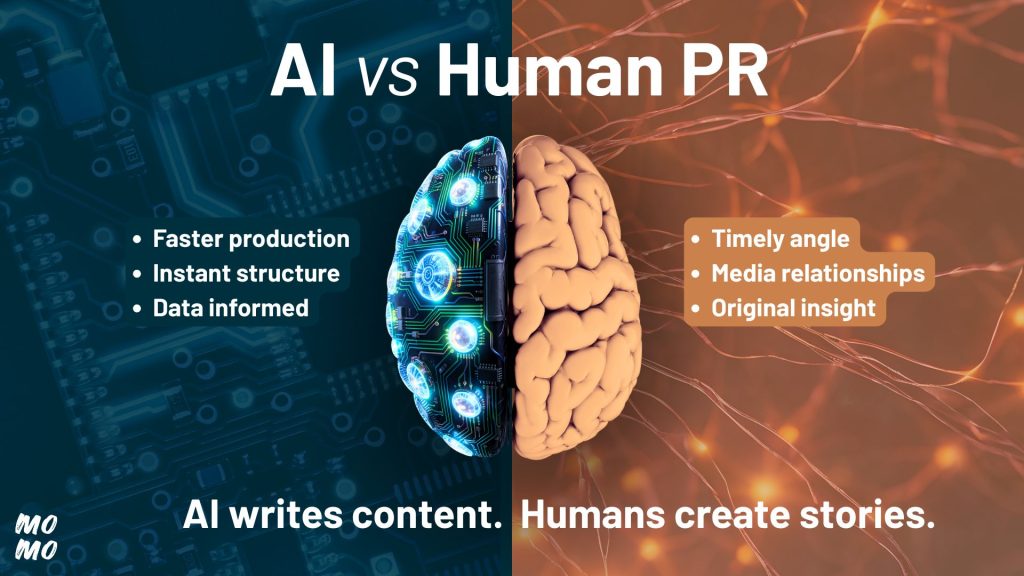
The AI-generated version lacked a strong news angle. It presented information, but it didn’t frame it in a way that made it feel timely or relevant. There was no clear “hook” to capture a journalist’s attention or justify why this story should be covered now.
It also missed original insight. Great press releases don’t just share announcements, they add something new. Whether that’s through data, expert commentary, or a unique perspective, journalists are looking for something they can’t easily replicate themselves. AI, without guidance, tends to default to generalisations rather than specificity.
Then there’s narrative. The human-written version told a story. It had a clear flow, a sense of purpose, and an understanding of the audience it was speaking to. It connected the announcement to a bigger picture, industry trends, audience challenges, and real-world impact. The AI version, while coherent, felt flat by comparison.
Timing was another factor we had considered. A strong press release doesn’t exist in isolation, it sits within a wider news cycle. Human PR professionals instinctively consider what else is happening in the media landscape and position their story accordingly. AI, unless explicitly prompted with that context, struggles to replicate this level of awareness.
And perhaps most importantly, there’s the human touch. Relationships, tone, nuance, these are all critical in PR. Journalists aren’t just receiving content; they’re engaging with people. A press release is often the starting point of a conversation, not the end product.
None of this is to say that AI doesn’t have a place in PR. In fact, quite the opposite.
At Momo Media, we actively use AI as part of our workflow, but not as a replacement for strategic thinking. We use it to speed up processes, organise ideas, and help shape initial storylines. It’s a powerful tool for improving efficiency and freeing up time to focus on additional projects.
But we don’t rely on it to do the thinking for us.
Ultimately, great PR isn’t just about producing content quickly. It’s about telling stories that matter. It’s about understanding audiences, identifying what makes a story newsworthy, and building relationships with the people who bring those stories to life in the media.
The real opportunity isn’t AI vs human PR. It’s AI combined with strategic communications expertise.
Used correctly, AI can enhance creativity, not replace it. It can support better storytelling, not shortcut it. And it can give PR professionals more time to focus on what they do best thinking, connecting, and creating narratives that resonate.
So yes, AI can write a press release in seconds. But journalists don’t publish press releases, they publish stories.
Landing meaningful media coverage still takes a human touch.
How do you think AI will shape the future of PR and media relations?